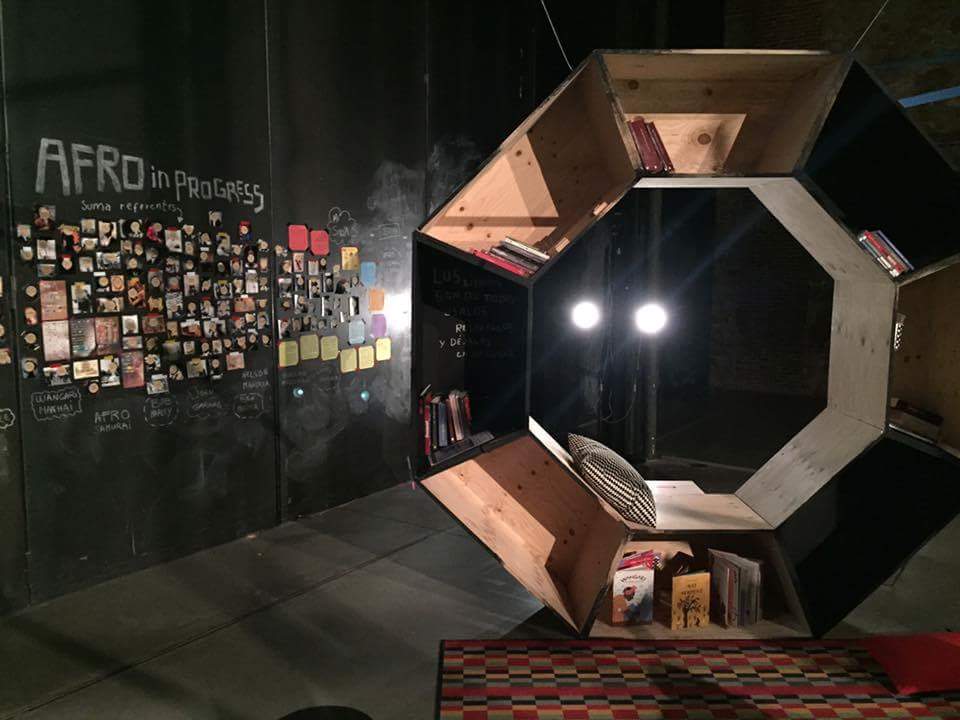
Ana Cebrián, Deborah Ekoka, Jose Oyono Ngalo, Yeison García López, Ken Province, Mariam Valencia, Yo Soy El Otro, Ityökó Bárbara Bolekia Morgades, Pablo Muñoz Rojo, Pour Meilleure Afrique, Nzola Sema, Shady El Sabbagh, Arturo Andersen Chinbuah.
Afro in Progress, 2015. Installation as part of the exhibition Ni arte ni educación (Neither Art nor Education) organised by Matadero Madrid.
https://www.niartenieducacion.com/project/afro-in-progress/
Afro in progress is an installation-archive conceived by artivist Ana Cebrián, which brought together proposals from the African diaspora on the references–texts, images, concepts, memories–that should form part of the education of young people of African descent. In response to the silencing of Black communities in Spain, where more than two million people of African descent live, the work denounces the gaps in formal and informal education, as well as the exclusion of this knowledge from the national narrative. The project highlighted the urgent need to build a collective memory that allows new generations to recognise themselves as historical subjects, creators of culture and agents of change.
Contextualization
On the path towards radical education in difference, it is useful to examine the link between critical pedagogies and anti-racist pedagogies in order to rethink education in contexts marked by structural inequalities and processes of racialisation of difference. Based on the contributions of culturally sustainable pedagogies (Paris and Alim, 2017), culturally relevant pedagogies (Ladson-Billings, 1995) and the pedagogy of the oppressed (Freire, 1970), a critical and anti-racist pedagogical proposal does not seek to adapt to the dominant educational model, but rather conceives of difference as a political, epistemic and affective force capable of reconfiguring the classroom as a learning community.
As Ladson-Billings (2006) argues, a culturally relevant pedagogy must start from the lived experiences of students and explicitly confront the power structures that place them in positions of otherness. From the perspective of critical anti-racist pedagogy, difference is understood as a field of social and political dispute, in which schools often function as an extension of the racial hierarchies present in society, reproducing inequalities through their content, methodologies and institutional relationships (Ladson-Billings, 1995). In this sense, talking about diversity without naming racism means sustaining the very structures of inequality that we seek to challenge.
From a methodological perspective, critical pedagogies also imply a profound transformation of the different levels that make up educational work. Among their central axes are the critique of the hidden curriculum, the Eurocentric logics of knowledge production and the institutional forms of control that reproduce processes of exclusion from the earliest stages of education.
The hidden curriculum (Apple, 1979) is one of the most effective mechanisms for reproducing racial inequality. It refers to those lessons that are transmitted and acquired in a non-explicit manner within the framework of educational practice. It includes the set of norms, values, beliefs, attitudes and behaviours which are implicitly conveyed through school organisation, power relations, institutional habits and everyday practices in educational centres, but which are not formally part of the official curriculum or study plans.
Examples of these dynamics include the absence of non-white histories, knowledge or languages in school content, which legitimises a Eurocentric view of knowledge; ‘coexistence’ protocols that apply more severe considerations, controls or labelling to racialised bodies or non-hegemonic forms of family life; institutional discourses that associate the language, religion or culture of the other with failure, risk or threat; and low academic expectations of certain students, which anticipate their failure and normalise their marginalisation.
Examples
There are numerous practices, experiences and initiatives in critical pedagogy throughout the world. Some of the best known are presented below.
Pedagogy of the oppressed (Paulo Freire, 1970) is a pedagogical proposal formulated by Paulo Freire based on the lessons learned from his work with oppressed communities in Brazil during the 1970s. The genealogy of this proposal lies at the intersection of broader theoretical frameworks, such as the Marxist tradition and Christian-based liberation theology, in the Latin American context.
Pedagogy of the oppressed conceives of education as a practice aimed at the liberation of oppressed peoples. To this end, it not only establishes a theoretical and political framework for education and pedagogical work, but also proposes the need for coherence between theory and practice — that is, between reflection and action — as the central axis of its proposal. In this sense, it contributes a series of pedagogical methods whose goal is to overcome different forms of oppression.
Critical pedagogy, strongly influenced by the thinking of Paulo Freire, seeks to transform education and society through conscientisation, understood as the ability to critically read the world in order to intervene in it. Freire questions so-called ‘banking education’, in which students play a passive role as recipients of information, and proposes instead an education that promotes critical reflection and transformative action.
The critical sociocultural approach, which builds on the contributions of Lev Vygotsky (1978), emphasises the role of cultural mediation and the importance of social interaction in learning processes. The relationship between scientific knowledge and everyday knowledge is central to understanding how learning is constructed in diverse educational contexts.
Cultural mediation is key to the development of meaningful learning, as it allows students to go beyond what they can do independently, facilitating the acquisition of new skills and knowledge. In this approach, the presence of other people with greater experience in the learning process responds to the need for dialogic relationships in education, in which participants learn and teach reciprocally, breaking with unidirectional models of teaching and learning (Vossoughi and Gutiérrez, 2016).
In this sense, Vygotsky – in dialogue with Freire’s pedagogical proposal – proposes the notion of the ‘zone of proximal development’ (ZPD), understood as the distance between what a person can do on their own and what they can do with the support of more experienced people. Working from the ZPD in an anti-racist way involves promoting learning that questions the hierarchies of knowledge, language and power present in the classroom, recognising the situated knowledge of students as a legitimate starting point for the educational process.
Activity
Words that name the world: from experience to action
Based on Paulo Freire’s pedagogical proposal of conscientisation, which uses words drawn from the everyday lives of oppressed people to facilitate literacy processes that are also processes of liberation, learning does not begin with imposed content, but with lived reality. This reality becomes the object of critical reflection and transformative action.
General objective
To develop critical awareness based on the students’ lived experience, promoting the reading and transformation of the world through their own words, knowledge and issues.
Specific objectives
- Identify themes and generative words based on the realities of the students.
- Transform the classroom into a space for collective research that recognises and activates prior knowledge.
- Highlight life experiences and knowledge as legitimate sources of knowledge.
Dialogue research: which words affect us?
- In small groups, students discuss everyday situations that are difficult, unfair, painful or invisible in different areas of their lives (school, neighbourhood, media, family, etc.).
- Based on these conversations, each group selects a generative word that summarises the problem identified, for example: racism, shame, silence, fear, passport, accent, gaze, uniform, injustice, control, border.
Note
The aim of this phase is to identify key words based on collective experience. This corresponds to Freire’s stage of exploring the lived world in order to turn it into an object of critical reflection, recognising experience as a source of knowledge.
Visual or narrative coding
- Each group creates a representation of the situation linked to their generative word through an image, a drawing, a collage, a short theatrical scene or a short narrative.
- The productions are not explained or evaluated at this stage; they are only presented or shown.
Note
Freire calls this process ‘codification’: the symbolic representation of a lived situation that allows its complexity to be observed without yet interpreting it. The aim is to create a critical distance that makes subsequent collective analysis possible.
Problematising dialogue in a circle
- Each group presents its coding and the whole class participates in a guided dialogue based on questions such as the following:
- What do we see here?
- Why is this happening?
- Who benefits from this situation?
- Is this a fair situation?
- Could it be any other way?
Note
This dialogue promotes a critical reading of the world. Teachers do not offer definitive answers, but rather accompany students in discovering the social and political meaning of their own experiences. The aim is to denaturalise what is represented and critically question reality.
Collective writing: words that transform
- Based on the collective analysis, the groups come up with a new word or phrase of action that expresses an alternative, a form of resistance or a horizon of transformation – for example, voice, organisation, recognition, linguistic justice, questioning, disobedience, solidarity.
- These words or phrases are integrated into a collective classroom manifesto entitled ‘Words to transform the school’.
Note
The aim of this phase is to rewrite reality from a critical consciousness oriented towards transformative action.
The words and issues worked on can be linked to the curriculum or the subject in which the activity is carried out. Some examples are:
- Language and Literature: narratives, oral stories and silenced histories. Oral expression, argumentation, written production and critical literacy are worked on.
- Social Sciences, Geography and History: deconstruction of the Eurocentric canon, identity and community, recognition of racially diverse experiences, situated knowledge and collective construction of meaning.
- Ethics and Civics: critique of models of citizenship, ethical reflection, rights, justice and collective agency.
- Foreign or co-official languages: cultural translation, linguistic resistance, linguistic awareness and analysis of language as a tool of oppression or liberation.
- Plastic and Visual Education: visual expression of non-hegemonic knowledge and symbolic representation of situated experiences.
Note
The role of teachers in this activity is to act as facilitators in the zone of proximal development (ZPD), helping to broaden reflection, document processes and link emerging knowledge to broader frameworks, such as colonial history, migration or collective resistance. Teachers do not need to be experts in the specific issue chosen by the students, but rather to accompany the process of critical knowledge construction.
Dialogue forum: ‘What kind of school do we want to build?’
A horizontal assembly is organised, in which the different groups present the maps and productions developed throughout the activity.
Based on these presentations, a collective dialogue is opened with questions such as the following:
- What would need to change in the classroom for all this knowledge to form part of the learning process?
- Which rules, forms of communication or assessment criteria make what each person knows and experiences invisible?
Public action: collective intervention in the school space
The group decides collectively how to share the work done with the educational community (families, teachers, faculty or management team). Some possible options are the creation of a mural, an exhibition, a school newspaper, a video or a collective manifesto.
Note
The aim of this phase is to ensure that the experience is not confined to the classroom, but challenges institutional hierarchies of knowledge and highlights the collective and situated production of knowledge from a perspective of difference.
The activity can be expanded and turned into a longer-term project, incorporating, for example, interviews with families, analysis of media discourse, writing public letters or community actions linked to the words and issues worked on.
Resources
Web page
- Fronteres invisibles. Website of a youth collective that promotes activities in educational spaces in Catalonia around migration, racism, and borders. The site includes teaching materials and links to educational and community projects. https://fronteresinvisible.wixsite.com/frinvisibles (Available in Catalan)
References
Apple, M. [Michael]. (2019). Ideology and curriculum. Routledge.
Freire, P. [Paulo]. (1970). Pedagogy of the oppressed. Herder and Herder.
Ladson-Billings, G. [Gloria]. (1995). Toward a theory of culturally relevant pedagogy. American Educational Research Journal, 32(3), 465–491.
Paris, D. [Django] and Alim, H. S. [H. Samy] (Eds.). (2017). Culturally sustaining pedagogies: Teaching and learning for justice in a changing world. Teachers College Press.
Vossoughi, S. [Shirin] and Gutiérrez, K. D. [Kris D.]. (2016). Critical pedagogy and sociocultural theory. In: Power and privilege in the learning sciences (pp. 157–179). Routledge.
Vygotsky, L. S. [Lev S.] and Cole, M. [Michael]. (1978). Mind in society: Development of higher psychological processes. Harvard University Press.