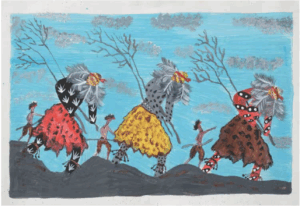
Salmi López Valbuena (Bahía Negra, Paraguay, 1982)
Untitled, 2021.
https://institutodevision.com/es/artistas/abel-rodriguez-2/
Courtesy of the artist and the mor-charpentier gallery
Salmi López Valvuena belongs to the Ishir community of the Paraguayan Chaco. For years, she travelled on the Aquidabán boat to reach Puerto Diana, a journey that was interrupted in 2023 when the service was suspended. In her community, where rituals have been reduced, traditions such as basket weaving and wood carving persist. She learned to paint by observing her grandfather Ogwa, a central figure in her life and education, whose legacy she shares with her uncles Rubén and Claudelino. Her works, inspired by Ishir culture, recreate rituals and everyday scenes, affirming the validity of other ways of life and knowledge. Using paper and canvas, her practice links memory, resistance and intergenerational transmission.
Contextualization
Epistemic racism is the idea that only one type of knowledge – that produced in Western universities, laboratories, or institutions, following scientific and rationalist logic – is valid as true or superior knowledge. This leads to other forms of knowledge, such as those that come from indigenous, Afro-descendant, peasant or non-Western communities, being considered less important, less valid or simply ignored (Lander, 2000).
This type of thinking has been heavily criticised by decolonial and postcolonial studies (Quijano, 2004; Mezzadra et al., 2008), because it reproduces a form of domination: not only economic or political, but also over how we understand the world and which voices have the authority to explain it.
In this sense, we speak of epistemic racism, when Western thinking is presented as the only legitimate way of thinking and producing knowledge that is valid for the entire population. It is associated with reason, objectivity and neutrality, while other ways of understanding reality are perceived only as beliefs, opinions or interpretations, and are therefore considered inferior or less reliable.
To overcome this, it is essential to address racism from a structural understanding. This distances us from its more liberal conception, which tends to explain it as a matter of irrational beliefs and attitudes, such as hate speech, which finds its explanatory roots in the rise of Nazism. The liberal tradition tends to see racism as a failure of democracy, undermined above all by right-wing political extremists who inflame racial hatred to gain power (Kundnani, 2024). Understanding racism as an element interwoven in the genesis, development and articulation of all political, economic, legal and cultural structures of social formation forces us to reposition the temporality and genealogy of racism in another socio-historical framework.
The tradition of radical black thought, for example, places the genesis of modern racism – as we know it today– at the dawn of European proto-capitalism (Robinson, 2019) and argues that its progressive expansion as a large system that organises and hierarchises territories and populations on a global scale cannot be separated from its function of distributing land, rights, resources and labour according to racial criteria established since the colonial era.
From the contributions of decolonial thought, the invasion of the Americas, as a historical process, established a pattern of power (coloniality of power) based on a racial hierarchy that justified the dichotomous logic of superiority/inferiority (Quijano, 2000) and imposed normative ideologies that positioned Europe as a supremacist hegemonic centre and the colonies as peripheries that ‘needed to be civilised’. This division constitutes the foundation on which Eurocentrism was established (Quijano, 2004).
From this perspective, it is possible to understand how relations of subalternity (Spivak, 2011) have been configured, as well as the control and denial of voices, experiences and histories that are relegated to the margins or directly rendered invisible or invalidated, as developed in postcolonial theory.
All these traditions of thought are characterised by their criticism of Eurocentrism in the construction of knowledge. Criticism of Eurocentrism is central to all theoretical traditions that confront the vestiges of colonialism. The concept refers to the tendency of disciplines such as Western sociology, philosophy, and anthropology, among others, to consider the European experience as the normative standard from which theories and analytical categories are constructed. This leads to the marginalisation of non-Western experiences and knowledge, as they are presented as particular. The way in which this contributes to perpetuating forms of epistemic exclusion is that the particular is always situated as an exception to the norm.
Examples
- Absence or marginalisation of non-Western knowledge: in subjects such as history, literature, philosophy and social sciences, official curricula tend to focus almost exclusively on Europe and North America. For example, the ‘Middle Ages’ are taught solely from a European perspective, without including the history of empires such as Mali or Songhai, or the Andean and Mesoamerican cultures of the same period.
- Social theories universalised from Europe: theories such as the social contract, liberalism or Marxism are presented as global explanations without discussing their limitations in describing contexts in the global South or the experiences of colonised peoples.
- Natural science programmes that only include ‘modern science’: they leave out systems of knowledge about agriculture, medicine or the environment developed by indigenous peoples, Afro-descendants or peasants, which are dismissed as ‘popular knowledge’ or ‘beliefs’.
- Assessments that privilege Western linear and logical modes of reasoning: sequential, objective thinking formulated in Eurocentric academic formats is considered ‘correct’, while narrative, symbolic or oral forms of thinking typical of other traditions are ignored or penalised.
- Teaching methods based on individual competitiveness: these are based on Western ideals of meritocracy, rather than the collective learning practices more common in many indigenous or Afro-descendant communities, where learning is a community process.
- Implementation of intercultural activities with a superficial approach: food festivals, clothing exhibitions or other actions that tend to exoticise ‘other’ cultures and avoid addressing the structural inequalities faced by these communities.
- Demand for ‘cultural adaptation’: for example, Roma, indigenous or racially diverse migrant children are forced to abandon their languages, customs or family socialisation patterns in order to fit into white, Eurocentric school ‘normality’.
- Linguistic integration plans that only recognise the native language as a legitimate language: the use of other languages – such as Arabic, Wolof or Quechua, among others – is sanctioned, made invisible or associated with learning difficulties.
- Lack of representation among teaching staff and management teams: in most schools in Spain and Europe, teaching staff and management teams are almost exclusively white, sending an implicit message that only those who embody the ‘European norm’ can be sources of knowledge and educational authority.
Activity
Objective
To help students identify Eurocentrism and epistemic racism in their books, subjects and school organisation; to encourage critical thinking about which voices and knowledge are valued or made invisible.
Discussion starters
In a large group, ask questions such as:
- What stories do we learn in History class? Where are they from?
- Which authors do we read in Language and Literature? Do we include non-European voices?
- What knowledge is considered ‘true’ in Natural Sciences? Where does it come from?
Dynamic
The answers are collected in a document or on a board, classified by subject (History, Science, Literature, etc.) and the results are analysed: where do most of the examples come from?
Observation
Form groups of 4-5 people and ask them to analyse some of the subject syllabuses or textbooks they regularly use in class.
They are asked to answer the following questions:
- Which countries or regions do the people, events or theories that appear come from?
- Does knowledge or perspectives from indigenous, African, Asian, Arab communities, etc. appear?
- How are they presented? As equals, as inferiors, as curiosities…?
- They note down textual examples or images.
Guided discussion
Each group presents what they have found. Some questions to accompany the reflection:
- What do you think when you see that almost everything studied comes from Europe or the United States?
- What knowledge or perspectives might be missing?
- Why is it important to have more voices represented in what we learn?
Creative proposal
In the same groups, students are asked to review the content, bibliography or resources of a subject and suggest how global knowledge or perspectives could be included, rather than just Eurocentric ones.
Sharing and closing
Each group shares its proposal.
- How would our view of the world change if this knowledge were included in our textbooks?
- Why do you think it is not usually included?
Resources
Readings and articles
- Chakrabarty, D. [Dipesh]. (2008). El pensamiento postcolonial y el artificio de la historia. In Al margen de Europa. Pensamiento poscolonial y diferencia histórica (pp. 57–80). Tusquets Editores. https://tristesantrotopicos.wordpress.com/wp-content/uploads/2012/10/chakrabarty_-_poscolonialidad_artificio_historia.pdf
- Museu Virtual del Poble Gitano a Catalunya. Campaña «Why is my curriculum white?». https://www.museuvirtualgitano.cat/en/.
- Ndiaye Mir, N. [Najat]. (2025). Disseny curricular i gestió de l’aula: propostes per repensar els continguts. La Disruptiva. https://ladisruptiva.cat/disseny-curricular-i-gestio-de-laula-propostes-per-repensar-els-continguts/.
- Nicholson, T. D. [Tracey D.]. (2022). Decolonising the curriculum toolkit. Manchester Metropolitan University. https://drive.google.com/file/d/1hbIDYUiO9-R2JJ9ZEM3MCzKmSIFd8mra/view.
- Peters, M. A. [Michael A.]. (2015). Why is My Curriculum White? Educational Philosophy and Theory, 47(7), 641–646. https://doi.org/10.1080/00131857.2015.1037227.
- Restrepo, E. [Eduardo]. (2016). Descentrando a Europa: Aportes de la teoría postcolonial y el giro decolonial al conocimiento situado. Revista Latina de Sociología (RELASO), 6, 60–71. https://doi.org/10.17979/relaso.2016.6.1.1965.
References
Kundnani, A. [Arun]. (2024). ¿Qué es el antirracismo? Y por qué significa anticapitalismo. Editorial Katakrak.
Lander, E. [Edgardo] (Comp.). (2000). Colonialidad del saber: Eurocentrismo y ciencias sociales. Perspectivas latinoamericanas. CLACSO.
Mezzadra, S. [Sandro], et al. (2008). Estudios postcoloniales: Ensayos fundamentales. Traficantes de Sueños.
Quijano, A. [Aníbal]. (2004). Colonialidad del poder, eurocentrismo y América Latina. In D. Mato [Daniel] (Coord.), Globalización y diversidad cultural: Una mirada desde América Latina (pp. 228–281). CLACSO; UNESCO.
Quijano, A. [Aníbal]. (2000). Colonialidad del poder y clasificación social. Journal of World-Systems Research, 11(2), 342–386.
Robinson, C. J. [Cedric J.]. (2019). Marxismo negro: La creación de la tradición radical negra. Traficantes de Sueños.
Spivak, G. C. [Gayatri Chakravorty]. (2011). ¿Pueden hablar los subalternos? El Cuenco de Plata.