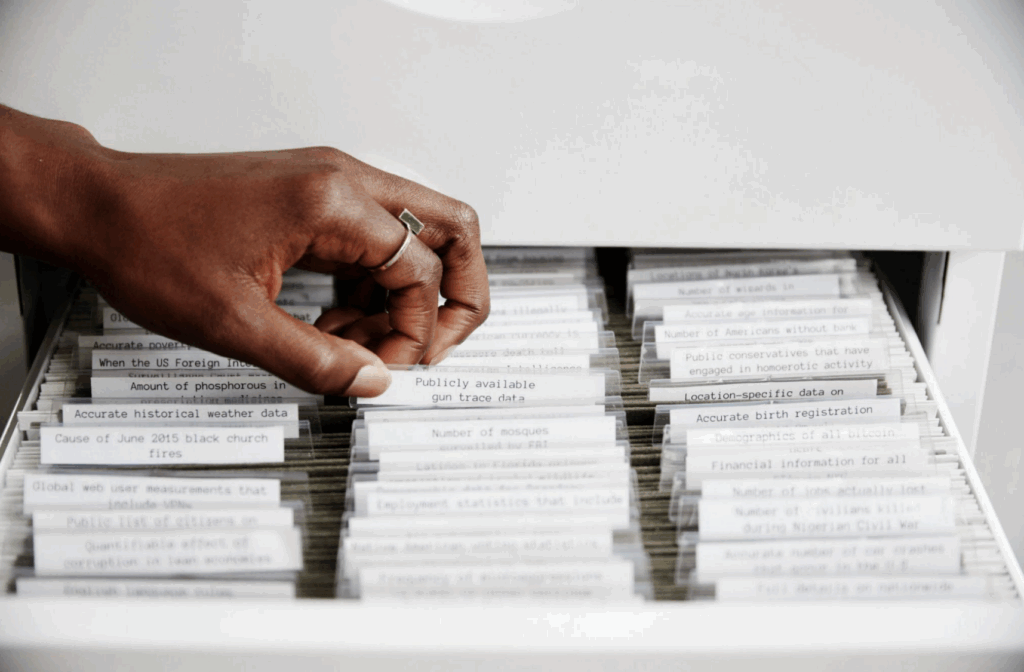
Mimi Ọnụọha (Nigeria)
The Library of Missing Datasets, 2016. Installation.
Courtesy of the artist.
https://mimionuoha.com/the-library-of-missing-datasets
The Library of Missing Datasets is a physical archive that brings together what has been excluded in a world saturated with information. The so-called ‘missing datasets’ are gaps that emerge precisely where data is most collected. In these hyper-recorded spaces, the absence of certain data is not accidental: it points to what has been ignored, omitted or considered irrelevant. In this way, the Library proposes a critical reflection on what we decide to keep, what we leave out and why. Gaps are not neutral.
Contextualization
The normalisation of racism as part of common sense
The fact that racism is perceived as normal reveals that common sense is steeped in racial logic. This process of normalisation is sustained, to a large extent, by the ability to conceal the origin of its violence – both symbolic and physical – under subterfuges that are not perceived as being influenced by the issue of race and racism. This invisibility serves precisely to keep it alive. The concealment is profound and takes many forms. This text will address only some of the faces that racism takes on.
Racism in political and legal rationality
When racism is cloaked in arguments considered rational – appealing to reason – such as political or legal discourse, it manages to conceal its racial nature. A clear example is the Immigration Law, which is presented as a purely legal norm, since it does not explicitly name racial categories and is justified by reasons such as ‘resource management’, ‘orderly migration’ or ‘national sovereignty’. However, it is precisely these justifications that support the creation of degrees of citizenship, labour exploitation, the restriction of fundamental rights, and even deaths during land or sea crossings.
Thus, concepts that are presented as neutral, universal, and ahistorical – such as citizenship, democracy, or the rule of law – despite being deeply intertwined with colonial history and its consequences, are not perceived as part of the universe of racism that must be confronted and dismantled (Douhaibi, Franco, and Contreras, 2025).
Racism hidden in narratives of development, progress and civic-mindedness
The ideas of development, progress and civic-mindedness are closely linked to the historical moment – colonialism – when Europe became the centre of religious, economic and military power in the world. This position was achieved through the massive extraction of resources and the forced and gratuitous exploitation of the labour of poor, indigenous and black people.
Racialisation, in this sense, should be understood as the process that allowed capitalism to organise the population into different levels of exploitation in order to maximise the accumulation of capital. This process constitutes the material basis that facilitated Europe’s transition to industrial capitalism (Romero Losacco, 2018).
At the end of the 18th century and throughout the 19th and 20th centuries, the discourse on European scientific progress was used to legitimise both global domination and class inequality within nation states themselves. The image of a superior Europe was constructed, whose supposed intelligence and civility explained its success over ‘backward’ peoples (Dussel, 1994).
Despite the brutality of colonialism and the wars necessary to consolidate this position, Europe continued – and continues – to present itself as the moral and political model to follow, placing its way of life as a universal benchmark for progress. The notion of civility was built on this genealogy, and it was disciplinary fields such as philosophy, sociology and anthropology that produced the theoretical frameworks that reinforced it (Dussel, 1994).
Racism camouflaged in the culturalist paradigm
Since the South-North migrations of the 20th and 21st centuries, the culturalist approach has gained prominence in the analysis of racial conflicts. This approach attributes social conflicts and socialisation dynamics to fixed ‘cultural expressions’ that define people. Models such as French assimilation, British multiculturalism, and Canadian interculturalism present people as mere carriers of a ‘national culture’.
This paradigm tends to homogenise and simplify reality, grouping profoundly diverse – and even conflicting – realities under the same cultural label: believers and atheists, indigenous and Creole, rich and poor, rural and urban, etc. Thus, factors such as social class, access to cultural goods, or whether one comes from an urban or rural context are left out of the analysis, displaced by a view that responds more to Western fictions than to real social complexities. This approach ends up equating state and culture (Shaimi, 2025), which is unsustainable in a globalised world, as well as producing representations that go beyond any concrete social reality. Internal tensions within societies do not disappear with migration.
In this way, interculturality has become an administrative management tool that uses culture as a smokescreen to avoid addressing phenomena with political and economic roots. By focusing on ‘promoting cultural diversity’ without guaranteeing rights and equality, it facilitates the disguise of racism with a friendly tone.
Ultimately, equality in access to rights does not depend on the willingness of migrants to adapt, but on institutional structures and public policies. When the distribution of resources and benefits is organised along racial lines, intercultural approaches, far from questioning this order, often contribute to sustaining covert racial logic (Douhaibi, Franco and Contreras, 2025).
Examples
- Raids based on racial profiling (police checks based on physical appearance) are justified as ‘security’ or ‘immigration control’ measures, when, in reality, they are directed almost exclusively at Arab, Roma, Black and Latin American people.
- ‘Development cooperation’ programmes or international aid that impose conditions on countries in the Global South, based on the idea that they are ‘backward’ and must follow the Western economic, political or social model in order to ‘progress’.
- NGO campaigns that show images of Black or indigenous children in extreme situations, reinforcing stereotypes of poverty and backwardness that justify the idea that Europe or the United States must ‘save’ them because they ‘know better’ how to live.
- The way in which the media presents conflicts on the African or Asian continents as the result of ‘tribal wars’, without mentioning the structural causes, such as colonial exploitation, military interventions or Western economic interests.
- Integration policies that require migrants to demonstrate their adaptation to ‘the values of the host society’ in order to access rights (e.g. through language and culture tests to renew permits), when many of these barriers do not apply to white migrants from countries such as the United States, Canada or Australia.
Activity
Uncovering invisible racism
Objective
To help identify how racism is normalised in laws, discourses on development and cultural narratives; to develop critical thinking in order to question these everyday expressions.
Brief introduction by the activity leader
- Explain, using language appropriate to the educational level at which the activity is being carried out, what structural racism is and how it can appear in hidden ways (as in the examples we saw: laws, discourses on progress or cultural ideas).
- Show one or two specific examples (e.g. police raids involving racial profiling or NGO campaigns that infantilise countries in the Global South) to illustrate the concept.
Group work
Divide the students into three groups:
- Group ‘Racism in law and politics’
- Group ‘Racism in the discourse of development and progress’
- Group: ‘Racism in cultural narratives’
Guided research
Each group should:
- Search the internet, social media, newspapers, or recall their own experiences or those of people close to them that fit the assigned category.
- Write down at least two real or recent examples from their school, neighbourhood or city.
- For each example, answer:
- Where is racism seen?
- Why does it seem ‘normal’ or accepted?
- How do you think it impacts racially diverse people?
- How do you think it impacts society in general?
Note
Secure links to digital newspapers, activist websites, critical NGOs, or short videos can be provided depending on the context to facilitate the activity.
Sharing
Each group presents their examples to the rest of the class on a poster, mural or slide, briefly explaining their answers.
Other people in the classroom are encouraged to ask questions or share similar situations they know of.
Discussion and conclusion
Reflect with the group:
- Why do you think it is so difficult to identify these issues as forms of racism?
- What could we do in our school or community to challenge them?
- How do we feel when we see these situations happening today?
Resources
Readings and articles
- SOS Racismo website with videos of people talking about racial profiling: https://sosracismo.eu/tag/paraddepararme/
- SOS Racisme Catalunya. (2018). Pareu de parar-me: L’aparença no és motiu. Guia de defensa davant les parades per perfil racial [digital guide]. https://sosracisme.org/guia-identificacions-policials-perfil-etnic
- Romero, E. (2011). Quién invade a quién. Oviedo: Editorial Cambalache.
References
Douhaibi Arrazola, A. N. [Ainhoa Nadia], Franco Méndez, L. [Lucía] and Contreras Hernández, P. [Patricia]. (2025). Miradas críticas sobre la exclusión social aquí y ahora (1st ed.) [textual learning resource]. Fundació Universitat Oberta de Catalunya (FUOC).
Dussel, E. [Enrique]. (1994). 1492: El encubrimiento del Otro. Plural Editores.
Romero Losacco, J. [Jesús]. (2018). La invención de la exclusión: Individuo, desarrollo e inclusión. Fundación Editorial El Perro y La Rana.
Shaimi, M. [Mostafà]. (2025). Superar l’interculturalisme. La Disruptiva. https://ladisruptiva.cat/superar-linterculturalisme/