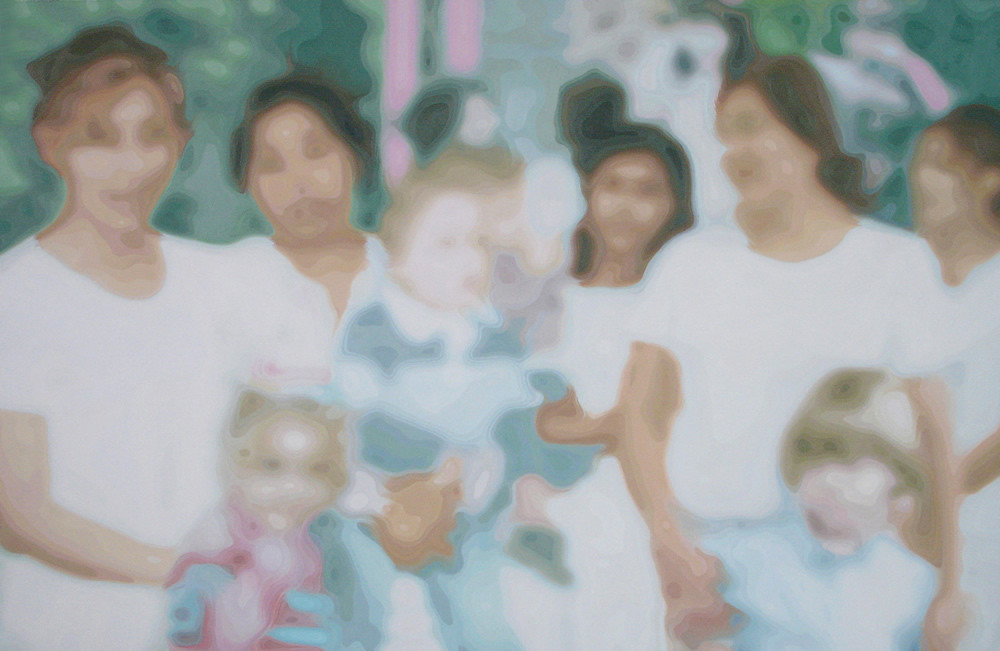
Adriana Tomatis Souverbielle (Perú)
Estudio de color, 2006 / 2007
Courtesy of the artist.
http://adrianatomatis.com/en/estudio-de-color/
In the series Estudio de color (Colour Study), Adriana Tomatis reflects on the invisible hierarchies that permeate class, race and gender relations. The title serves as a critical clue: it refers to the pictorial palette and the racialised categorisation that has historically placed racialised women–especially domestic workers–on the margins of social visibility. The work denounces the intersectional gaps that shape domestic intimacy: women of colour and working-class origin whose presence is silenced and aestheticised, subtly reproducing the violence of the colonial order in everyday life.
Contextualization
The question of how the co-constitution and intersecting of different systems of domination give rise to specific situations of oppression has been widely addressed by black feminists (Jabardo et al., 2012). These schools of thought fall within the framework of both feminist and anti-racist theories, and argue that sexism, class oppression and racism are closely interrelated. From this perspective, it is not possible to carry out a separate analysis – monofocal paradigm – or a merely cumulative analysis – multiple oppressions paradigm – of the way in which these systems operate and produce concrete and contextualised forms of oppression.
The black feminist movement emerged at the confluence – and also in the tension – between two historical movements: abolitionism and suffragism. Despite having a significant presence in both, the combination of racism and sexism ended up excluding black women from these spaces of struggle. Although the analysis of intersecting oppressions has become hegemonic in Europe based on the theory of intersectionality, formulated by black feminists and lesbians in the United States, there are theoretical frameworks and experiences of struggle that precede it by almost a century.
In this regard, as early as the 1980s, authors such as bell hooks (1981) and Patricia Hill Collins (1989, 1991) contributed fundamental reflections on the joint articulation of inequalities produced by different systems of oppression. However, it was in the 1990s that Kimberlé Crenshaw (1989) coined and popularised the concept of intersectionality, providing it with a specific analytical framework.
To better understand the scope of this analytical shift, it is useful to contrast it with the development of modern enlightened feminism, articulated around Simone de Beauvoir and her well-known statement: ‘One is not born a woman, one becomes one’. In contrast to this formulation, black feminist gender discourses are based on an experience of denial and exclusion, expressed paradigmatically in the question posed by Sojourner Truth at the Ohio Women’s Rights Convention in 1851: ‘Ain’t I a woman?’
In this regard, it is essential to mention Angela Davis’ seminal work Women, Race and Class (1981), which develops a pioneering analysis of how the relationship between capitalism, race and gender relegated black women in the plantation economy to a social position that was not being challenged by the feminisms of the time. Taking the colonial history of the United States as her main frame of reference, Davis shows how black women, since the period of slavery, have been subjected to a specific form of exploitation that combines gender oppression and racial exploitation.
In her analysis, Davis argues that capitalist oppression cannot be adequately understood without considering the inseparable interweaving of race and gender dynamics in the lives of black women, who have experienced forms of subjugation distinct from both white women and black men. From this perspective, the author advocates for a conception of feminism that recognises the multiple forms of oppression and exploitation that affect black women and other racially diverse women in terms of gender, race, and class.
Another key author for this approach is the Jamaican sociologist Stuart Hall, who, based on his analysis of British society in the context of postcolonial migration from the Caribbean, made fundamental contributions to understanding how race and racialisation processes shape the class experience of new migrant populations in the metropolis (Hall, 1980, 1998, 2023).
In any case, the strength of an anti-capitalist, feminist and anti-racist analysis – that is, an approach that understands that systems of power cannot be analysed separately – lies in its critique of reductionist or monofocal theories. In relation to white feminism, this critique is articulated in two main directions. On the one hand, the invisibility of the voices and experiences of black or racially diverse women reinforces the exclusions they suffer. On the other hand, the separate analysis of the causes and consequences of patriarchy and racism contributes to a universalist and reductionist conception of women’s issues, favouring the homogenisation of female subjectivity based on the experience of white, middle-class, heterosexual women.
Similarly, in the case of class reductionism, the critique formulated by Hall and other authors has highlighted the lack of attention to structural racism and the role of neocolonialism in shaping contemporary post-industrial societies.
Examples
Feminised and racialised work in the home and care sector
According to data from the International Labour Organisation (ILO), 80% of paid domestic work worldwide is done by women, which is equivalent to approximately 67 million people. In high-income countries, 66% of these workers are migrants. Thus, the feminisation of poverty, the feminisation of labour and the feminisation of migration converge and articulate themselves in a matrix of racial, imperial and class power.
This intersection is evident, for example, in the analyses of Selma James (2023) and Maria Mies (2019), who explain how the work of migrant domestic workers contributes directly to the accumulation of wealth by middle- and upper-class women in advanced capitalist countries. The latter are ‘freed’ from domestic and care work – historically unpaid – in order to climb the professional and corporate ladder.
In this sense, as Harsha Walia (2022) points out, migrant domestic workers become “a colonial solution to the ‘domestic labour problem’” for global capital. This racialised and exploitative division of labour consolidates hierarchies between, on the one hand, white middle- and upper-class women integrated into the so-called ‘productive economy’ and, on the other, low-income racialised migrant women relegated to an undervalued and poorly paid care economy.
This analysis highlights the limitations of the feminisation of poverty paradigm, which, by focusing exclusively on the wage gap or the so-called ‘glass ceiling’, fails to explain the intensification of poverty in terms of race and migration. The case of migrant domestic work thus underscores the need for an approach that explicitly incorporates the intersectionality of race, gender and class in order to understand the dynamics of inequality in contemporary capitalism.
Criminalisation of migrant children
The idea of childhood is deeply associated with the notion of protection. However, this association does not operate universally. A clear example is the legal-administrative and media-reinforced category used to refer to children and adolescents who migrate without the company of an adult: MENA. This form of categorisation has contributed to excluding these children from the hegemonic imaginary of childhood, and, consequently, from the supposed protection attributed to it.
This imaginary affects not only migrant children, but also children living in poverty, from the Roma community or other racialised groups, who are often treated as suspicious, dangerous or intrusive subjects, especially in migratory contexts. This case illustrates how a monofocal view, based on a universal and abstract category of ‘boy’ or ‘girl’, is insufficient to understand the forms of institutional violence – and even neglect – to which these children are subjected.
Institutional racism and the expulsion of racialised young people from school in urban contexts
The Autonomous Community of Catalonia (Spain) has been trying for years to address the serious consequences of school segregation. For a long time, this debate has taken place without explicitly naming racism, until organised families directly affected have managed to bring it to light. In official reports and emergency plans to combat segregation, the tendency has been to favour a socio-economic analysis to explain the territorial configuration of the populations and schools affected.
As a result, the territorial distribution of children in public schools in the areas most affected by segregation continues to produce centres with high levels of enrolment and nursery classrooms in which there are very few or no children who speak Spanish or Catalan. In turn, internal segregation is reproduced in primary education through level groups that systematically place children of migrant families – whether born in the territory or abroad – at the lowest levels of the education system.
This is an example of how a single-focus analysis of public policies, centred exclusively on class, has failed to resolve the problem of educational segregation.
Activity
Am I not a woman?
Objectives
- To understand what intersecting oppressions are and how they operate based on a specific historical experience.
- Reflect on how race, gender, and class intersect in the production of inequality.
- To make historically silenced voices visible in educational processes.
Introduction
The speech is projected (link available in the resources section) or an excerpt from Sojourner Truth’s speech is written on the board:
‘I have ploughed, I have sown, and I have reaped in the barns, and no man could surpass me. And ain’t I a woman? I could work as much as a man and eat as much as a man when I had food. And I could stand the whip too! And ain’t I a woman? I’ve borne thirteen children, and I’ve seen most of them sold into slavery. And when I cried out with my mother’s grief, no one but Jesus could hear me. And ain’t I a woman?’
(Excerpt from the speech ‘Am I Not a Woman?’, taken from Women, Race and Class by Angela Davis).
Guided discussion
Based on the reading of the excerpt, a guided discussion is proposed based on the following questions:
- What is Sojourner Truth narrating in this speech?
- Who was Sojourner Truth and in which historical context did she speak?
- What did it mean to be an enslaved black woman in the 19th century?
- Which political struggles coexisted at that time (abolition of slavery and women’s suffrage)?
- Did black women obtain the right to vote at the same time as white women in the United States? What happened in other contexts or countries?
Guided activity
The following questions are suggested for group work:
- Which injustices did Sojourner Truth experience that other white women did not?
- Which injustices do some women experience today that others do not necessarily face?
- Which connections can be made with the present day?
- How can these differences be overcome in order to articulate common struggles against injustice in a more solid and effective manner?
Each group writes down their ideas and shares them with the rest of the class.
Based on the collective reflections, each group – or individual – writes a short speech from a perspective that intersects several axes of oppression (e.g. that of a migrant woman, a migrant teenager, a transgender person, an impoverished person, etc.), questioning the notion of abstract universality using phrases such as the following:
- ‘Am I not a woman?’
- ‘Am I not a child?’
- ‘Am I not working class?’
- ‘Am I not…?’
Closing
The texts are read aloud, simulating a collective agreement.
Resources
Readings
- Lugones, M. [María]. (2008). Colonialidad y género. Tabula Rasa, (9), 73–102. http://www.scielo.org.co/pdf/tara/n9/n9a06.pdf
Audiovisual material
- Recording of Sojourner Truth’s speech (‘Ain’t I a Woman?’) https://www.youtube.com/watch?v=V090_BhJw3Y
- Reproduction of Sojourner Truth’s speech, subtitled in Spanish. https://www.youtube.com/watch?v=fu9vjEmGFjU
- Feminismo interseccional: un feminismo diverso. Short video. https://www.youtube.com/watch?v=ixOlUfPSl-E (Available in Spanish)
- Brizuela, F. Video lecture on the background and genealogy of intersectionality. https://www.youtube.com/watch?v=Z_Ur1kSV1_Y (Available in Spanish)
References
Crenshaw, K. W. [Kimberlé Williams]. (1989). Demarginalising the intersection of race and sex: A black feminist critique of antidiscrimination doctrine (pp. 139–168). University of Chicago Legal Forum, 1.
Davis, A. [Angela]. (1981 [2004]). Mujeres, raza y clase. Ediciones Akal.
Hall, S. [Stuart]. (1980). Race, articulation and societies structured in dominance. In S. Hall (2018), Essential essays (Vol. 1). Duke University Press.
Hall, S. [Stuart]. (1998). Subjects in history: Making diasporic identities. In S. Hall (2021), Selected writings on race and difference. Duke University Press.
Hall, S. [Stuart], et al. (2023 [1979]). Gobernar la crisis: Los atracos, el Estado y «la ley y el orden». Traficantes de Sueños.
Hill Collins, P. [Patricia]. (1989). The social construction of Black feminist thought. Signs, 14(4), 745–773.
Hill Collins, P. [Patricia]. (1991). On our own terms: Self-defined standpoints and curriculum transformation. NWSA Journal, 3(3), 367–381.
Hooks, b. [bell]. (1981 [2020]). ¿Acaso no soy una mujer? Mujeres negras y feminismo. Consonni.
Jabardo, M. [María] (Ed.), Truth, S. [Sojourner], Wells, I. [Ida B.], Hill Collins, P. [Patricia], Davis, A. [Angela], Stack, C. [Carol], Carby, H. [Hazel], Parmar, P. [Pratibha], Ifekwunigwe, J. [Jayne] and Ang-Lygate, M. [Madeleine]. (2012). Feminismos negros: Una antología. Traficantes de Sueños.
James, S. [Selma]. (2023 [2012]). Sexo, raza, clase: Una perspectiva para vencer. Traficantes de Sueños.
Mies, M. [Maria]. (2019). Patriarcado y acumulación a escala mundial. Traficantes de Sueños.