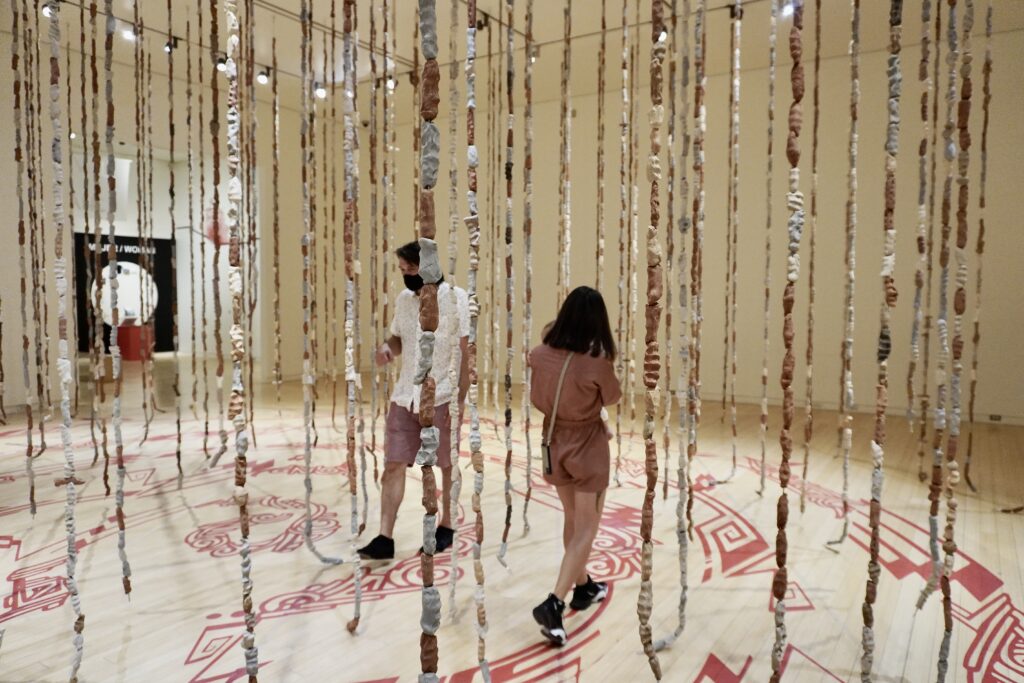
Cannupa Hanska Luger (North Dakota)
Something to Hold Onto, 2021. Installation.
https://www.cannupahanska.com/social-engagement/stho
What happens when borders cross bodies and memories? Something to Hold Onto collects more than 9,000 handmade clay beads from communities in Mexico and the United States to honour indigenous migrants who have lost their lives on routes interrupted by violence, confinement and border control. Each clay bead contains a human gesture, a trace, a story.
Contextualization
Borders should not be understood exclusively as rigid, unbreakable walls that clearly separate countries or citizens from non-citizens. In fact, even when we refer to them as dividing devices, they do not begin or end at walls and fences; rather, border externalisation can extend thousands of kilometres beyond the ‘official border’. For this and other reasons that we will explain, it is more useful to understand borders as a complex set of practices that operate both outside and inside nation states, serving to maintain Western imperial order and white supremacy (Walia, 2022).
Rather than simply marking an ‘outside’ and an ‘inside’ of the state, borders articulate a network of devices that organise and hierarchise social space. In this sense, it is not enough to analyse how border controls reinforce differences between states or reify racial categories inherited from colonialism. It is also necessary to consider how these border logics are transferred within territories through multiple forms of social control: school segregation, criminalisation, police persecution, detention centres for foreigners, and prisons. Far from being an exception, these forms of internal borders are part of a privileged device for managing populations.
Thus, it is more useful to think of borders as ‘categories that organise space’ and as a ‘device for articulating social space’. Far from being limited to a geopolitical line, borders are blurred in a multitude of mechanisms and institutions that penetrate the daily lives of individuals. These internal borders allow for the (re)production of multiple differential social positions, all of which are marked by varying degrees of inequality and vulnerability (Pérez et al., 2019).
Through a myriad of forms – laws, rules, directives, regulations, police controls, bureaucratic obstacles, administrative sanctions, or differential treatment – the population is distributed into positions marked by differences in status, income, education, or access to social guarantees. In this context, borders do not operate solely as mechanisms of exclusion: they are also key technologies of differential inclusion, devices that allow fragmented and unequal access to social, labour and economic rights (Pérez et al., 2019).
This logic is clearly evident in current legislation. An analysis of the main laws regulating access to basic rights shows that total legal exclusion does not always exist. What is most often observed is regulatory hyper-fragmentation that turns access to these rights into an obstacle course. The various immigration, civil law, supranational and European laws provide for a multitude of regularisation routes, resulting in a virtually infinite fragmentation of legal statuses. Each of these statuses is associated with differential and conditional rights, further reinforcing inequality.
This leads us, in turn, to demystify the liberal narrative that celebrated globalisation as the beginning of a ‘world without borders’. What has actually happened is the opposite: an intensification and multiplication of border forms. Borders have not disappeared; they have been transformed into mobile and flexible mechanisms that operate beyond the territorial limits of the state. They manifest themselves in legal, digital or labour forms and selectively regulate who can move, under what conditions and with what rights (Mezzadra and Neilson, 2017).
In this way, the border becomes a central infrastructure for the production of inequality, both globally and locally. It is not a remnant of the past that globalisation has left behind, but a key technology of contemporary neoliberalism for governing labour and populations.
In short, it is no longer enough to think of the border as a line separating territories: today it is a distributed device that manages, classifies and hierarchises. It is deployed in migration controls, risk algorithms, visa policies, digital surveillance and corporate outsourcing. Its strategic function is clear: to regulate who can move, how they can do so and under what conditions they can be exploited or criminalised, upholding the promise of mobility for a few and the punishment of immobility or deportation for the majority.
Examples
Selective mobility: visas and passports
People with European or US passports can enter more than 150 countries without a visa, while those with passports from countries in the Global South face severe restrictions. For example, an Afghan or Eritrean person needs multiple visas to cross borders that a person with European citizenship could cross without additional checks. This clearly shows how borders operate differently depending on origin: they are not ‘the same for everyone’.
Outsourcing of migration control
The EU signs agreements with countries such as Libya, Turkey and Morocco to control the departure of migrants before they reach European territory. The United States delegates control of migration flows towards its borders to Mexico and even Central American countries.
This shifts border control outside the territory that is intended to be crossed (mobile border).
Digital classification and surveillance systems
In the US and the UK, risk prediction algorithms decide whether or not to grant a visa or allow a person to board a flight. Frontex and other EU agencies are developing predictive surveillance systems based on big data to ‘detect migration risks’ before they occur.
Legal fragmentation and differential citizenship status
The Immigration Act establishes dozens of legal categories (temporary residence, residence based on ties to the country, residence for humanitarian reasons, etc.), each with different rights and, in many cases, conditional permits. For example, a person with a permit based on social ties can access certain jobs, but is not entitled to unemployment benefits or immediate family reunification.
In turn, the extension of the permit is conditional on the continuity of their contributions to the public treasury.
Foreigners’ Detention Centres (CIE)
CIEs are border facilities within the territory where undocumented persons are detained for not having a residence permit. There, an internal border of enormous clarity is created: deprivation of liberty without full judicial guarantees, inhuman treatment and institutional racism.
Unequal access to social rights
In Spain, public healthcare is not universal in practice: undocumented persons or those with precarious status must meet administrative conditions in order to receive regular healthcare. Although Royal Decree-Law 7/2018 extended universal access to healthcare, many autonomous communities continue to impose barriers such as continuous registration for three months, which excludes persons who lack residence or who are mobile.
The practice of notifying the police authorities has led to the detention and deportation of individuals, increasing deterrence among the undocumented population and exacerbating their vulnerability.
School segregation and urban boundaries
What are referred to as ‘high-complexity schools’ are in fact schools with marked racialisation: they generally have a very high proportion of migrant pupils, continuous enrolments throughout the year, and, often, lower public investment in relation to the needs arising from these dynamics.
These ‘urban boundaries’ reproduce racial and class hierarchies from childhood, conditioning the future educational and employment paths of young people.
Racial profiling in police checks
Checks carried out in public spaces, such as transport stations or public roads, are a systemic practice that operates as a tangible internal border. This practice constantly reaffirms a hierarchy of belonging that distinguishes between people perceived as members of the community and those who are assigned a status of exclusion.
Activity
Where are the borders?
Reflect on how borders operate beyond walls: at school, in the city and in everyday life.
Objectives
- Understand that borders are not just physical lines between countries, but devices that operate within our societies.
- Identify specific examples of ‘internal borders’.
- Recognise the effects of borders on people’s rights, mobility and daily lives.
- Develop a critical view of institutional racism and normalised inequalities.
Warm-up: What is a border?
What comes to mind when you think of a border?
We expand on the reflection if it has not come up before:
What if borders were also here, in the city, at school, in access to a doctor, to work or even in bureaucratic procedures?
Group work: Mapping everyday borders
Divide the class into small groups. Each group is assigned several real examples of borders (see examples below).
- Each group should classify the examples according to the type of border (legal, social, police, educational, labour, etc.).
- Place these borders on a symbolic map: where do they operate? Who do they affect? What rights do they condition?
Sharing and reflection
Each group presents two or three examples that they found most relevant, surprising or little known.
Questions that can help guide the conversation:
- Which boundary did you find most invisible but most serious?
- Who is left outside or inside according to these borders?
- What role does the state play?
- How does racism manifest itself at these borders?
Closing
Briefly explain or summarise how the examples show that borders are more than walls: they function as tools for producing inequalities.
Introduce the idea that borders are not natural, but rather produced, historically situated and politically convenient for normalising forms of violence that a non-racialised common sense would lead us to question and reject.
The session can be concluded by showing a short video (5–10 minutes) that shows a real example (such as racial profiling at checkpoints, immigration detention centres, barriers to registration, etc.) to continue the discussion and reflect on the need for violence to maintain borders.
Closing or follow-up reflection:
What would a society without internal borders look like?
Examples of borders for mapping
You can adapt the number according to the group.
Each example can include a brief description + a guiding question:
Border 1. Immigration Law
Migrants are required to demonstrate employment or social ties and have a job offer in order to obtain a residence permit. This requirement often forces them to accept precarious working conditions as a condition for regularising their immigration status or maintaining their legal status.
What effects does this state regulation have on the labour niches where the majority of the migrant population is employed (hospitality, care, agriculture, etc.)?
Border 2. Racial profiling by the police
At stations and on public roads, the police often ask racially diverse people for their documentation under legal pretexts: ‘they are looking for a suspect and you look like him’; ‘they think you are a foreigner and ask you for your residence documentation’.
Does this affect everyone equally? How would you experience it? Which bodies represent the condition of (non) citizenship?
Border 3. Public and universal healthcare?
Undocumented people must prove three months of residence to access the healthcare system.
What happens if someone cannot register?
Border 4. School segregation
In most cities, public schools have a much higher concentration of migrant students, while private and state-subsidised private schools have a majority of native students.
Does this school segregation create inequality?
A very high percentage of migrant and racialised students’ educational paths end before they reach secondary school and university.
Why and how does this happen?
Border 5. Precarious work
Many migrants work in sectors such as agriculture, domestic and care work, and catering without a contract, with abusive working hours and no legal protection.
Why is there less protection in these sectors?
Border 6. Impossible procedures
Although the law allows for the regularisation of a person’s status, it often requires documents that are difficult to obtain (such as certificates from the country of origin); or it involves a complex bureaucratic obstacle course; or there are no appointments available for processing the documentation, etc.
What effects can these obstacles have on people’s lives?
Border 7. Migration risk algorithms
Predictive algorithmic systems implemented in Europe assess a person’s level of risk based on criteria that may include their nationality or history.
What are the effects and ethical implications of transferring decision-making responsibility to automated systems?
Resources
Audiovisual material
- Documentary: ‘Tarajal. Desmuntant la impunitat a la frontera sud’ (Tarajal. Dismantling impunity at the southern border)
This documentary denounces the events that took place on 6 February 2014, when at least 15 people drowned in Ceuta, on the border between Spain and Morocco. A group of more than 200 migrants attempted to enter via Tarajal beach and were repelled by Civil Guard officers with rubber bullets and smoke canisters while still in the sea. https://www.filmin.cat/pelicula/tarajal-desmuntant-la-impunitat-a-la-frontera-sud (available in Catalan) - Documentary: Express
Audiovisual project by Next Project and the CIEs NO Madrid campaign (Foreigners’ Detention Centres). Directed by Juan Herreros and Carlos Olalla. For the closure of the CIEs and an end to deportations. No person is illegal. https://vimeo.com/170911673?p=0l - Conversación online entre Robin D.G. Kelley y la autora del libro Border and Rule Harsha Walia organizado por Haymarket Books (11 febrero 2021). Border and Rule: Global Migration, Capitalism, and Racist Nationalism
- Border and Rule offers an unflinching examination of migration as a pillar of global governance and the formation of racial and gender classes. Harsha Walia disrupts simplistic explanations of migrant and refugee crises, showing them to be inevitable outcomes of conquest, capitalist globalisation, and climate change – processes that generate massive dispossession around the world. Border and Rule explores a series of seemingly disparate global geographies with shared logics of border rule that displace, immobilise, criminalise, exploit, and expel migrants and refugees. With her keen ability to connect processes, Walia demonstrates how borders divide the international working class and consolidate the imperial and capitalist domination of elites. Ambitious in its scope and internationalist in its orientation, Border and Rule challenges exceptionalist and liberal American responses to the migration crisis and offers a compelling analysis of the connections between state violence, capitalism, and right-wing nationalism on a global scale.
Readings and articles
-
Shaimi, M. [Mostafà]. (2021). La segregació educativa també és racisme. Directa. https://directa.cat/la-segregacio-escolar-tambe-es-racisme/ (Available in Catalan)
-
Douhaibi Arrazola, A. N. [Ainhoa Nadia] and Almela, V. [Vicent]. Vigilància de frontera aplicada a les escoles. Directa. https://directa.cat/vigilancia-de-frontera-aplicada-a-les-escoles/ (Available in Catalan)
-
Douhaibi Arrazola, A. N. [Ainhoa Nadia]. (2024). El teatre polític: què fer amb les fronteres i la infància que migra. Directa. https://directa.cat/el-teatre-politic-que-fer-amb-les-fronteres-i-la-infancia-que-migra/ (Available in Catalan)
References
Mezzadra, S. [Sandro], and Neilson, B. [Brett]. (2017). La frontera como método o la multiplicación del trabajo. Traficantes de Sueños.
Pérez, M. [Marta], Ayala Rubio, A. [Ariadna], Ávila, D. [Débora] and García García, S. [Sergio]. (2019). Fronteras interiores: las prácticas informales en el gobierno de la desigualdad en España. Revista CIDOB d’Afers Internacionals, (122), 111–135. https://doi.org/10.24241/rcai.2019.122.2.111
Walia, H. [Harsha]. (2022). Frontera y ley: Migración global, capitalismo y el auge del nacionalismo racista. Editorial Raig Verd.