Marilyn Boror (Guatemala, 1984)
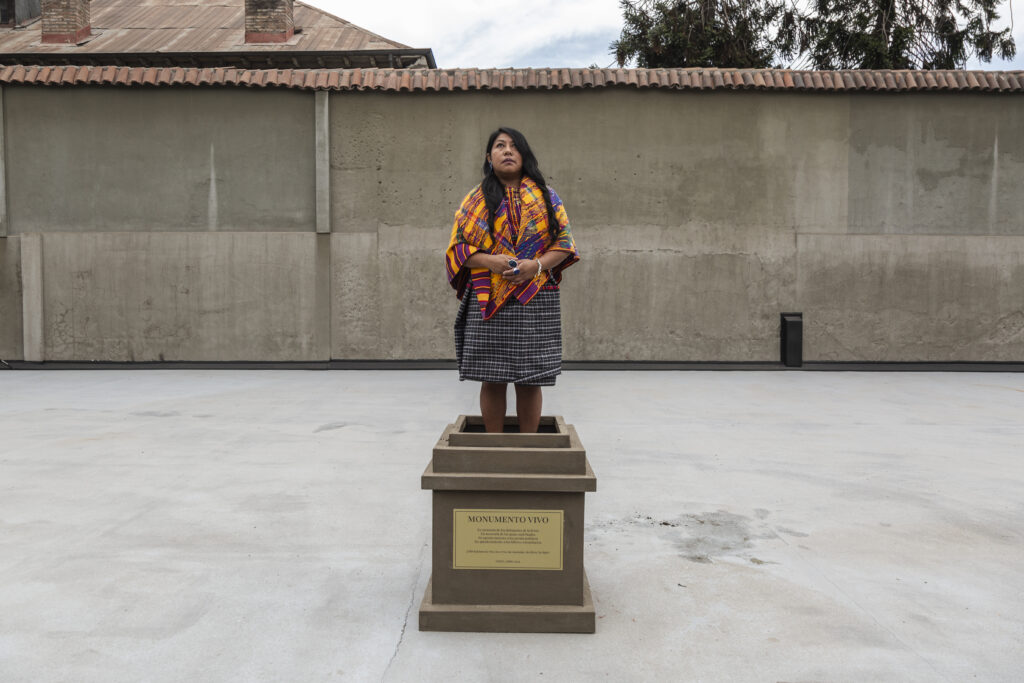
Living Monument, 2024. Performance as part of the exhibition Fugas de lo nuestro. Indigenous Visualities from South to North, curated by Cristián Vargas Paillahueque, at the Salvador Allende Solidarity Museum (MSSA), 2024. Photo: Benjamín Matte.
Courtesy of the artist
https://marilynboror.com/monumento-vivo/
Living Monument is a performance in which the artist, an indigenous Maya-Kaqchiquel woman, turns her body into a living monument of resistance. Dressed in traditional San Juan Sacatepéquez clothing, she remains motionless while liquid cement solidifies her ankles, symbolising the historical oppression of indigenous bodies and territories. The work denounces the extractivism that affects her community, where the cement industry has deprived the population of water. Through a commemorative plaque, Boror Bor pays tribute to defenders of the land and political prisoners. The use of cement refers to the structural violence of imposed progress. The action transforms immobilisation into an act of collective memory and resistance.
Contextualization
Broadly speaking, the term racial capitalism refers to the idea that capitalist development, as a global economic system, cannot be fully understood without taking into account the history of colonialism. In turn, the fundamental mechanism of the intertwining of capitalism and colonialism was the creation of law and, in particular, property law along racial lines. Brenna Bhandar (2018) uses the concept of ‘colonial property regimes’ to explain the process by which modern property laws – developed in colonial and settlement contexts – not only facilitated the appropriation of indigenous lands, but also defined racial structures of citizenship and rights.
The idea of ‘racial capitalism’ is best known through the author Cedric J. Robinson (1983), who, in his influential book Black Marxism: The Making of the Black Radical Tradition, took the term – used by South African Marxists and communists to describe how capitalism and racism reinforced each other in South Africa – and turned it into a theory capable of explaining not only what was happening in that context, but also the general functioning of capitalism. His main contribution is to show that racism is not a side effect of capitalism: capitalism was born and developed on the basis of pre-existing racial hierarchies.
For this author, even before colonial expansion, discrimination and hierarchies already existed in Europe between different peoples, regions and cultures, which assigned greater or lesser value to lives based on their origin. This logic was transferred and amplified with colonialism. To explain this, Robinson introduces the concept of ‘racial calculation’. By this term, he refers to a way of thinking, adopted by European elites, which combined cultural, religious or regional differences and reinterpreted them as ‘racial differences’. This classification was not just an abstract construct, but was materialised in the organisation of labour, politics and the economy. Thus, categories of people who could be exploited more harshly were created, which served to justify extreme inequalities.
In this sense, capitalism did not seek to eliminate pre-existing social differences in order to produce a single homogeneous working class, but rather intensified them and transformed them into racial hierarchies with the aim of making exploitation more efficient and profitable. The process of racialisation therefore consisted of assigning a different value to people as a labour force: some lives were ‘worth less’ than others, and this devaluation legitimised particularly violent forms of exploitation.
Robinson insists that this process is not a mistake or an excess within capitalism, but one of its essential features: racism is not an accidental addition, but a foundational element. Therefore, according to the author, it is not possible to understand phenomena such as transatlantic slavery, European colonialism or apartheid systems as isolated episodes, but rather as expressions of the way in which capitalism relies on racialisation to exist and expand in different contexts.
From this perspective, the concept of racial capitalism becomes a key tool for analysing why such profound racial and economic inequalities persist today. These inequalities are the result of centuries of a system that uses the idea of race to divide and exploit working populations. White supremacy – understood as the idea that white people are superior – is thus configured as the ideological basis that allows capitalism to function the way it does.
Ultimately, from the perspective of the radical Black tradition, race and racism are central to explaining how inequality and dynamics of exclusion are maintained in the capitalist era. Therefore, when we talk about ‘racial capitalism’, we are referring to the way in which capitalism, anywhere in the world, creates and exploits racial inequalities to naturalise forms of exploitation aimed at obtaining greater profits. Furthermore, this analysis is linked to the gender system: patriarchy causes women, especially racialised women, to suffer specific forms of exploitation and dispossession.
Examples
Land (dis)possession: property regime in Palestine
A current example of the use of law as a mechanism for updating colonial property regimes is the way in which the Israeli regime applies property laws that allow land belonging to the Palestinian population forcibly displaced since the Nakba of 1948 to be declared ‘absentee property’, transferring it to the state or to settlers. This use of property law to legitimise expropriation reflects what Bhandar (2018) documents in his work: law as an instrument for racialising land ownership and dispossessing the non-dominant population.
This logic is comparable to the concept of Terra nullius, meaning ‘no man’s land’. In international law, this concept has been used to justify the occupation of territories that were not under the sovereignty of any recognised state. It was particularly relevant in the context of European colonial expansion, where it served to legitimise the occupation of lands inhabited by indigenous peoples who were not considered legitimate owners according to European legal standards.
Gentrification processes in racialised contexts
In historically working-class or racialised neighbourhoods, gentrification processes resort to the logic of ‘improvement’ or ‘sanitation’ to justify the displacement of working-class, migrant or racialised communities. The purchase and transformation of real estate is based on a right of ownership that ignores pre-existing social relations, reproducing colonial dynamics of ‘progress’ and spatial planning according to white or bourgeois standards.
Immigration law in Spain
As Romero (2010) points out, the extension of residence permits for migrant workers is legally conditional on continued contributions to the Spanish tax system. By linking permanence in the country to economic contribution under threat of administrative sanctions, this regulation operates as an instrument designed to ensure the availability of labour for the productive system.
In this sense, it is the state itself that puts the mechanisms necessary for the reproduction of a logic of accumulation at the service of the interests of the labour market. By forcing the migrant workforce to comply with certain legal contribution parameters, migration regulation reinforces the dynamics of capital aimed at maximising economic profit through labour exploitation.
This mechanism not only guarantees the availability of labour, but also contributes effectively to reducing the price of labour in the most deregulated and precarious labour niches, such as agriculture, construction, and care and domestic work sectors (Douhaibi, 2022).
Activity
The Cost of Living
Objectives
- To understand what racial capitalism is in basic terms and how racism and economic inequality are interrelated.
- Reflect on examples from your own experience or from history that show how racial discrimination has been used to exploit certain social groups and generate wealth.
Activation
In a large group, ask the following question:
—Why do some people seem to have more opportunities than others from birth?
As a visual aid, you can project or distribute images of two clearly contrasting neighbourhoods – one with abundant services and the other deteriorated – as well as examples of job niches that demonstrate the racial division of labour.
The group is asked to describe the differences they have observed: who lives in each place? How do they think these situations came about?
In the case of an activity carried out over more than one session, a documentary or short film can be used to work on the content based on what has been observed. Two suggestions are offered in the resources section, although these can be adapted depending on the context and local variations of racial capitalism.
Brief explanation
Racial capitalism refers to a system in which racism operates as a fundamental instrument for the accumulation of capital, as it legitimises the devaluation of the work, lives and territories of certain groups of people. This logic is manifested, for example, in the disparity in value that the system assigns to different types of work: the labour rights and remuneration of those working in agriculture or the care sector are considerably less protected than those of professionals in fields such as graphic design, technology or programming.
These differences are not accidental, but are sustained by long-standing structural inequalities that allow capital to generate greater profits at the expense of the exploitation of racialised populations.
Group dynamics: ‘The map of inequality’
The class is divided into small groups.
Each group is assigned a brief case study, for example:
- Cobalt mining in the Democratic Republic of Congo.
- Evictions and dispossessions in urban neighbourhoods.
- Migrants in an irregular administrative situation working in the agricultural sector.
- The processes of colonisation and land appropriation from indigenous peoples.
Each group must answer the following questions:
- Who benefits financially from this process?
- Who is harmed?
- What role does racism play?
To conclude the activity, the groups can represent the ‘map of inequality’ using a graphic representation (diagram, chart or concept map).
Sharing and closing
Each group briefly presents the conclusions of their work.
The following question is then posed to the whole class:
Are there any recurring patterns among the different cases analysed? Why do you think this is?
The collective reflection is guided by the idea that racism cannot be understood solely as an expression of individual hatred or prejudice. This explanation is insufficient to understand the existence of an international and racial division of labour. To understand how racism has functioned as a foundation for the unequal organisation of the economy, it is necessary to identify and analyse different structural mechanisms, such as laws, borders, institutional racism and migration policies, among others.
Resources
Audiovisual material
-
Geographies of Racial Capitalism with Ruth Wilson Gilmore – An Antipode Foundation film. https://antipodefoundation.org
- Appearance by Jornaleras de Huelva en Lucha en el Parlamento Andaluz (16/07/2024). https://www.youtube.com/watch?v=RQVREt_7q8E (Available in Spanish)
Reading
- Kundnani, A. [Arun]. (2022). Capitalismo racial. Editorial Cambalache. (Available in Spanish)
Films and short films
-
Oro rojo (2021), by Carme Gomila. https://www.filmin.es/corto/oro-rojo (Available in Spanish)
-
Hotel explotación: Las Kellys (2018), by Georgina Cisquella. https://www.filmin.es/pelicula/hotel-explotacion-las-kellys (Available in Spanish)
References
Bhandar, B. [Brenna]. (2018). Colonial lives of property: Law, land, and racial regimes of ownership. Duke University Press.
Douhaibi, A. N. [Amina Naim]. (2022). Foreword. In A. Kundnani [Arun], Capitalismo racial. Editorial Cambalache.
Robinson, C. J. (Cedric J.). (1983 [2019]). Marxismo negro: La creación de la tradición radical negra. Traficantes de Sueños.
Romero, E. [Emma]. (2010). Un deseo apasionado de trabajo más barato y servicial. Editorial Cambalache.