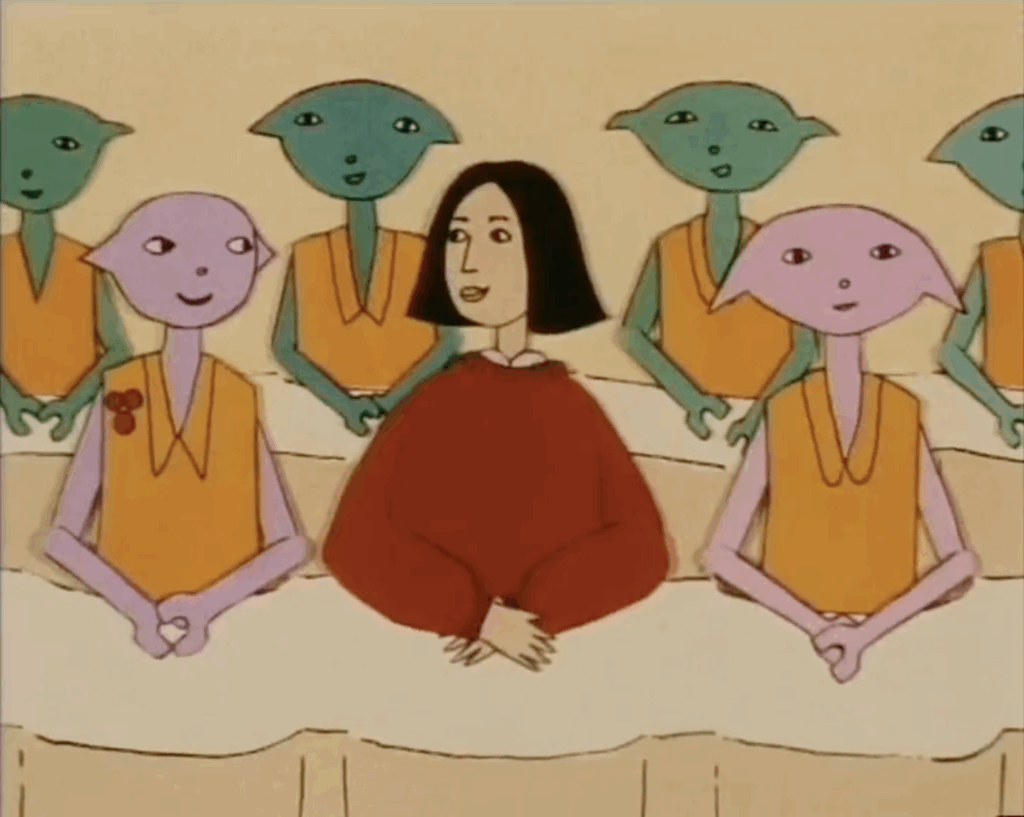
Leeds Animation Workshop
A World of Difference, 1997. Animation.
https://www.youtube.com/watch?v=o0syCJA2KSI&ab_channel=leedsanimation
A World of Difference was created by Leeds Animation Workshop, a feminist independent film collective founded in 1978 and recognised for its commitment to critical education and socially conscious animation. In this short film, young Natalie is abducted by a spaceship and taken to Helicon, a planet where the school system reproduces institutionalised forms of racism and exclusion. Her mission is to understand why the students in the Purple group are underperforming. In this environment, bullying, segregation and cultural denial are part of the curriculum. From her floating saucer, Natalie observes tell-tale signs: protective uniforms, popular songs with disturbing meanings, disfigured self-portraits. Questions pile up: what happened to the Purple Studies? Why does no one question this normalisation of violence? Her experience in an Earth school that has made some progress allows her to intervene effectively. In Helicon, she promotes small transformations. Back on Earth, she is ready to confront those who harassed her.
Contextualization
For years, explanations attributing the misnamed ‘dropout’ and ‘school failure’ to psychological and individual causes, such as alleged learning problems, demotivation, lack of attention, or even a presumed absence of a ‘culture of effort’ in certain historically marginalised communities affected by processes of racialisation, have been taken for granted. When going beyond a strictly individual approach, sociological explanations have focused on pointing out deficiencies in the family environment, such as low socio-economic and educational levels, limited participation or communication with the school, or linguistic differences (Douhaibi and Franco, 2025).
This type of discourse, widely disseminated in both scientific literature and public policy, has contributed to reinforcing the stigmas that weigh on historically marginalised populations, attributing to them the responsibility for their exclusion from the education system.
This fact sheet therefore proposes a shift in the narrative from which we observe and intervene in what educational sociology has termed ‘early school leaving’ or ‘school failure’. Replacing these notions with that of exclusion allows us to focus on the institutional mechanisms that produce educational inequality.
‘We refer to trajectories of school expulsion as a set of institutional educational actions and measures that create a path of educational exclusion throughout the different school stages, determining access to knowledge and learning opportunities and contributing to school expulsion’
(Zhang, González and Guitart, 2025, p. 18)
When these educational actions and measures are carried out in a veiled manner – without naming racial categories such as ‘migrant’, ‘diverse students’ or ‘Roma students’ – or explicitly, based on racial markers, and contribute to the creation of unequal and exclusionary pathways, it is necessary to name them as practices and mechanisms of institutional racism in the field of formal education.
Understanding the forms that institutional racism takes in the education system in order to identify and highlight the mechanisms and practices that racialise educational trajectories – that is, that generate differentiated experiences and paths based on racial markers or constructs – implies, for example, asking how measures deployed under the framework of an apparently inclusive education are contributing to educational (in)equity and, at the same time, how they are tracing differentiated itineraries in young people (Zhang, González and Guitart, 2025).
It is very difficult to identify a specific practice or situation that has, in isolation, led to a person’s definitive departure from the education system. Therefore, a comprehensive and critical view that aims to intervene in a recurring trend must focus on the mechanisms that contribute to producing it. In this sense, the mechanisms of school expulsion refer both to dynamics external to the school and to endogenous dynamics specific to education systems.
On the one hand, there are external mechanisms, such as educational laws and plans or the distribution of students among schools. On the other hand, there are internal mechanisms, such as pedagogical models, the creation of long-term special classrooms, power relations in the school-family-student triangle, discriminatory dynamics, and the hidden curriculum, understood as the set of ‘representations of the social world, images, descriptions, explanations, and frameworks for understanding how the world is and how it works in the way it is said and shown to work’ (Hall, 2010). These elements are interrelated and contribute jointly to the racialisation of educational trajectories.
Examples
Administrative and institutional practices or actions
These practices operate within the regulatory and organisational framework of the education system:
- Unequal school zoning: delimitation of enrolment zones that concentrate migrant or working-class students in certain schools, creating ‘ghettoised’ schools.
- Seemingly inclusive protocols and plans that result in forms of racialised separation, such as the unnecessary prolongation of reception classrooms.
- Eurocentric curriculum design: content and narratives that exclude the knowledge, languages and histories of racialised communities.
- Ghettoisation of elites and marginalised groups: coexistence of schools considered to be academically excellent with others that concentrate migrant or Roma students, classified as ‘highly complex’.
- Implementation of education laws that introduce early pathways or standardised assessments, with disproportionate effects on racialised students.
Assimilationist, integrationist or segregating practices
These practices are linked to the pedagogical and cultural policies that operate in the classroom:
- Pedagogical models that privilege the white norm, denying the linguistic or cultural repertoires of racialised students, for example by sanctioning the use of other languages in the classroom.
- Special or extended support classrooms, which end up functioning as spaces of permanent segregation under the guise of ‘reinforcement’.
- Education referred to as inclusive under conditions of assimilation, in which participation is only legitimised if students conform to the dominant codes.
- Epistemic supremacy, in which knowledge considered legitimate continues to be Western and white, rendering epistemologies and knowledge from other sources invisible.
Role of educational staff
This level encompasses the mechanisms of everyday institutional mediation, such as guidance, assessment and the expectations projected onto students:
- Biased educational and university guidance: systematic recommendation to migrant or Roma students of non-university pathways (‘basic vocational training’, ‘the practical will suit you better’). Added to this is misinformation or a lack of support in accessing scholarships, university studies or mobility programmes, as well as the consideration of the academic aspirations of racialised students as ‘unrealistic’.
- Pygmalion effect: low expectations of the performance and abilities of racialised students, which ultimately become self-fulfilling.
- Pathologisation of cultural difference: interpretation of behaviours, communication styles or forms of relationship as signs of conflict or deficit.
- Extension of social control: transformation of teaching and guidance staff into agents of cultural and moral normalisation.
Direct educational interaction
This level refers to the everyday experience that occurs in the relationships between school, students and families:
- Differences in everyday treatment: increased surveillance, quicker application of sanctions or lack of trust towards racialised students.
- Distrust of families: attribution of disinterest or lack of involvement without recognising existing institutional, administrative or linguistic barriers.
- White flight: withdrawal of white families from schools with a growing presence of migrant or Roma students, leading to processes of indirect school segregation.
- Racialised hidden curriculum: transmission of implicit messages about who legitimately belongs in the school environment, for example through the examples used, images or the assignment of leadership roles.
Structural dynamics (exogenous and endogenous to the education system)
These dynamics refer to structural conditions that permeate the education system as a whole and contribute to the reproduction of racial and class inequalities:
- Unequal distribution of resources among schools, which perpetuates educational gaps based on the racial and class composition of the student body.
- Unequal power relations in the school-family-student triangle, in which the voices of racialised families tend to be delegitimised or infantilised.
- Standardised assessment policies that penalise linguistic diversity and different learning styles.
- Media and political representations of ‘school failure’ that reinforce the image of certain communities – such as migrants, racialised populations or, specifically, the Roma community – as deficient or incapable of academic progress.
Activity
Beyond labels: the power of expectations
General objective
To reflect on how expectations – positive or negative – projected onto others influence their performance and self-esteem, especially in the educational context.
Specific objectives
- Understand what the Pygmalion effect is and how it operates in the educational setting.
- Recognise how prejudices and stereotypes influence the expectations that are built up about students.
- Promote equitable and respectful attitudes in teacher-student relationships.
- Design proposals aimed at building educational relationships based on the recognition of potential, rather than the imposition of labels.
Introduction: What do we know about the Pygmalion effect?
To begin the activity, hold a brief discussion in the classroom or write a guiding question about the concept on the board:
- ‘Have you ever felt that someone didn’t expect much from you?’
- ‘Or, on the contrary, that they trusted you even without knowing you well?’
Next, show a short video to introduce the concept of the Pygmalion effect (short video: ¿Qué es el efecto Pigmalión?).
Brief explanation of the concept
The Pygmalion effect is a psychological phenomenon whereby the expectations that one person projects onto another influence their behaviour and performance. In education, this can manifest itself when teachers have low expectations of some students based on prejudices or stereotypes, which ultimately has a negative impact on their performance. Conversely, high expectations can promote more positive learning processes.
Main activity
In groups, cards are made with labels and stereotypes that circulate in the classroom, in the school or in society in general. They may include labels linked to the educational sphere (e.g. ‘lazy’, ‘repeater’, ‘absent-minded’), as well as social labels related to class, race, and gender (e.g. ‘weak’, ‘dangerous’, ‘suspicious’, ‘strong’, ‘hard-working’, ‘docile’).
Small group work
In groups of three or four, several cards with these profiles are distributed.
Analysis and discussion
Each group discusses or writes answers to questions such as the following:
- Are there groups of people or communities to which these labels are attributed regardless of their individuality?
- These perceptions are not always explicit. In what subtle ways can differences in expectations towards different people or groups manifest themselves in the classroom or in other educational contexts?
- How do you think these labels influence relationships within the classroom?
- What kind of expectations might teachers project onto a person associated with this label?
Production of a counter-narrative
Each group chooses a label or stereotype and develops a short counter-narrative in the format they deem most appropriate. Some possible options are:
- A proposal for a short podcast.
- A mural or poster.
- A short play or sketch.
Collective reflection and proposed action to prevent the Pygmalion effect and stereotypes
Based on the work carried out, each group proposes a commitment or specific action that both teachers and students can implement to prevent the Pygmalion effect and the reproduction of stereotypes in the educational environment.
Some examples of possible actions are:
- Avoid comments such as ‘we didn’t expect you to do so well’, which reinforce low prior expectations.
- Do not make judgements based on appearance, accent or academic history.
- Recognise and allow multiple forms of expression of knowledge so that students can demonstrate their abilities in different ways.
Resources
Audiovisual material
Soler, Alberto. ¿Qué es el efecto Pigmalión? [Video]. Psychology Capsules. https://www.youtube.com/watch?v=_qC8Dtq-BcA (Available in Spanish)
References
Douhaibi Arrazola, A. N. [Ainhoa Nadia], Franco Méndez, L. [Lucía] and Contreras Hernández, P. [Patricia]. (2025). Miradas críticas sobre la exclusión social aquí y ahora (1st ed.) [textual learning resource]. Fundació Universitat Oberta de Catalunya (FUOC).
Hall, S. [Stuart]. (2010). Sin garantías: Trayectorias y problemáticas en estudios culturales. Envión Editores.
Zhang Yu, C. [Cristina], González Ceballos, I. [Isabel] and Esteban Guitart, M. [Manuel]. (2025). De l’abandonament a les trajectòries d’expulsió escolar: Els processos de racialització en l’àmbit educatiu [Report]. Fundació Bofill. https://fundaciobofill.cat/uploads/docs/q/4/u/twx-abandonament_processosracialitzacio.pdf